
This is the thesis in the part of Pneumonia detection of the research project including research problem, literature review ,objectives and research gap.
Radiology is a one of the most important area in western medicine practice. It has been used to diagnose very important health issues and diseases. Generally, the disease can be diagnosed from chest X-ray images by an expert radiologist. Also early diagnosis is an important factor for a successful treatment process. But the diagnoses can be subjective and the process of detection by reading X-ray images can be time consuming for some reasons such as the appearance of disease which can be unclear in chest X-ray images or can be confused with other diseases. Therefore, computer-aided diagnosis systems are needed to guide the radiologist. In this study, we expect to develop a web viewer for detecting the presence of pneumonia in the lungs. Convolutional neural network model is constructed using deep learning approaches and extract features from a given chest X-ray image and classify and classify it to determine if a person is infected with pneumonia. Furthermore several data augmentation algorithms are used to solve the problem of small dataset, overfitting problems and increase the efficiency of the CNN model. As a result of our application, it can guarantee timely access to treatment and save much needed time and money for those already experiencing radiologist’s poverty by increasing the accuracy and the efficiency of the radiology. These results are promising for further development of xray-based diagnosis using the deep learning approach.
Literature Survey
Though there are some literature available for detecting the presence of pneumonia form X-ray images, but less number of researchers has been conducted with the combination of the above-mentioned area. In 2017, Antin et al. used a DenseNet-121 layer with utilizing transfer leaning method for detecting pneumonia . For this project, They have focused on binary classification and used t-SNE (TDistributed Stochastic Neighbor Embedding) to classify a particular X-Ray as having pneumonia or not. There are multiple images from many of the patients, and in order to ensure that models do not see data from the same patient across training and test, they have separated the data by patient before splitting into training, validation, and test sets and have begun with a brief exploration of the data using unsupervised techniques. For the sake of data exploration, 500 random samples have been explored due to resource constraints. They have achieved 0.60% area under the curve (AUC) value. In 2017, Rajpurkar proposed a 121-layer convolutional neural network based on DenseNet and named as CheXNet. They trained their network with 10.000 frontal view chest X-ray images with 14 different diseases. They have assessed the performance of their network with four expert radiologists in f1 score metric which is the harmonic average of the precision and recall metrics. CheXNet achieved a f1 score of 0.435. In 2017, Abhishek Sharma, , Daniel Rajuetal, Sutapa Ranjan presented a approach for detecting the presence of pneumonia clouds in chest X-rays (CXR) by using only Image processing techniques. For this, they have worked on 40 analog chest CXRs pertaining to Normal and Pneumonia infected patients. Indigenous algorithms have been deployed for cropping and for extraction of the lung region from the images. To detect pneumonia clouds they have used Otsu thresholding which will segregate the healthy part of lung from the pneumonia infected cloudy regions.
Research Gap
Several types of researches have been done for the past few years about the systems that can detect presence of pneumonia in the lungs. When considering the previous researches, we found certain limitations and future works. Therefore, we propose a system in order to overcome above-mentioned limitations and come up with a new product with improved features.
Solving the problem of small dataset
Unlike other deep learning classification tasks with sufficient image repository, specially it is difficult to obtain a large amount of pneumonia classification tasks ; therefore, several data augmentation algorithms are deployed to improve the validation and classification accuracy. But in the few of previous researches., they have developed a algorithms to solve the problem of small dataset.
Access through the internet.
In the previous researches, they have developed only a model to classify and detect the presence of pneumonia in the human Body, but We implement the product with a web viewer for classifying tasks. Furthermore, the System is developed to store patient’s details and diagnosis in a PACS server. So that the Physician and patient can view information about presence of the pneumonia efficiently in anywhere .It helps to increase the access area to medical imaging expertise in parts of the world where access to skilled radiologists is limited.
Efficiency
Several data augmentation algorithms are deployed to improve the classification accuracy. In the Some of the previous systems addressed these feature. In our system this is done in the preprocessing and data augmentation stage by doing such as decreasing image size.
Overfitting Problem
Several data augmentation methods to artificially increase the size and quality of the dataset. This process helps in solving overfitting problems. But the most of previous researches haven’t addressed about this problem.
Research Problem
X-ray plays an important role in the human life. because X-Rays can be widely used for diagnosing so many abnormalities in the human body. Cysts Tumors, Asthma Cancers, Heart failure, Fractures, Lung diseases and conditions are some of them. but, At global level according to the latest estimates from the WHO .Each year in the United States, more than 250,000 people have to seek care in a hospital due to pneumonia, unfortunately, about 50,000 people die from the disease each year in the United States Over 150 million people get infected with pneumonia on an annual basis especially children under 5 years old. According to these information a huge number of people are suffering and dead in pneumonia in the lungs. Vaccines and appropriate treatment (like antibiotics and antivirals) can prevent many of these deaths, but the reason for large amount of deaths that in some regions, like in Africa’s 57 nations, a gap of 2.3 million doctors and nurses exists . The main reason for the poverty of the radiologists is that the process of pneumonia detection reading a X-ray can be time consuming for some reasons such as the appearance of disease which can be unclear in chest X-ray images and can be confused with other diseases.
-
In computer-aided systems , there are no web viewers which are classifying and detecting the pneumonia in the lungs.
-
Patient can meet the physician only at the time duration of the appointments and there is a no possible way to assess it at home to physician and radiologist, if there is a immediate situation.
-
The working area of the radiologist has limited due to time consuming things.
-
If the radiologist has to leave from the hospital , then there is a no way to diagnose for a very sick person.
Research Objectives
Main Objectives
The main objectives of the proposed system are to support to radiologists for timely accessing to treatment and saving much needed time and money in order to already experiencing radiologist’s poverty by producing a web viewer to detect presence of pneumonia using deep learning approaches.
Specific Objectives
Increasing the accuracy of the reading a X-ray to detect the presence of pneumonia.
Several data augmentation methods are deployed to artificially increase the size and quality of the dataset. This process helps in enhances the model’s generalization ability during training. the process of pneumonia detection by reading X-ray images can be time consuming and less accurate. The reason is that several other medical conditions i.e. lung cancer, excess fluid etc. can also show similar opacities in images. Therefore, accurate reading of images is highly desirable.
Increasing the efficiency of the radiologist
Unlike other methods that rely solely on transfer learning approaches or traditional handcrafted techniques to achieve a remarkable classification performance, a convolutional neural network model is constructed from scratch to extract features from a given chest X-ray image and classify it to determine if a person is infected with pneumonia. These approaches save the time of radiologist.
Allow access to radiologist work remotely
This system allows to radiologist to detect and send the report to physician remotely.
Methodology
Pneumonia Detection Algorithm
Data Pre-processing and Augmentation.
Several data augmentation methods are employed several data augmentation methods to artificially increase the size and quality of the dataset as shown in the figure 3.4. This process helps to solve overfitting problems and enhance the model’s generalization in the training. The rescale operation denotes image reduction or magnification in the augmentation process. The rotation range represents the range in which the images are randomly rotated during training. Width shift is the horizontal translation of the images and height shift is the vertical translation of the image. Also the shear range is the image angles in a clockwise direction. Finally images are flipped horizontally. Augmentation process helps to assist in fitting the small dataset into deep convolutional neural network architecture increase the efficiency and increase the accuracy. In addition overfitting problems are solved.
Model used in the Prediction
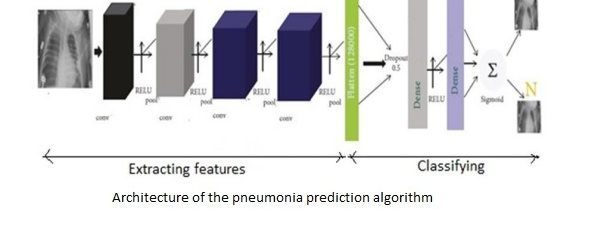
Overall model is a CNN. Overall architecture of the proposed model consists with two major parts: the feature extractors and a classifier(sigmoid activation function).
- Feature extraction
Each layer in the feature extraction layer takes its immediate previous layer’s output as input. And it’s output is passed as an input to the succeeding layers. The proposed architecture consists of the convolution, max-pooling(effective in variant shape absorptions and comprises sparse connections in conjunction with tied weights) and classification layers combined together .The feature extractors comprise convolutional layer max-pooling layer and a RELU activator between them. The output of the convolutional and max-pooling operations are assembled into 2d planes.. It is worthy to note that each plane of a layer in the network is obtained by combining one or more planes of previous layers.
- Classification
Classifier is placed at the far end of the purposed Convolutional network(CNN) model. It is simply an artificial neural network(ANN) often called as a dense layer. This classifier requires individual features(vectors) to perform calculations like any other classifier. Therefore the output of the feature extractor is converted into a 1D feature vector for the classifiers. This process is known as flattening where the output of the convolution operation is flattened to generate one lengthy feature vector for the dense layer to use in its final classification process. Classification layer contains a flattened layer, a dropout , two dense layers respectively, a RELU between the two dense layers and a sigmoid activation function that performs the classification tasks.
Technologies Used
Python
Python was used as the main programming language mainly due to its extensive selection of libraries and frameworks focusing on machine learning , the simple syntax helps to collaborate with the rest of the team members, concise readable code, extensive support from high quality documentation and active community of developers that offer assistance. CNN was constructed using python and deployed using python flask in the backend. Few main libraries were used. to implement and it’s explained in next sub section
- Tensorflow
One of the most famous and widely used deep learning libraries is the Google tensorflow. Google uses deep learning techniques to improve their own products, as an example google search recommendation system is a direct result of machine learning and deep learning techniques. Tensorflow architecture has three parts which are processing the data, building the model and training and estimating the outcome. This architecture is really helpful to our research as I wanted to train the X-ray images and get an outcome of whether the image contains any abnormalities or diseases. This library does contain a lot of options to image preprocessing which is a very important part of deep learning research. Tensorflow also supports a large variety of algorithms including linear regression, classification, deep learning classification and much more. This has also contributed to the fact that this library is becoming more famous day by day. As C++ the main programming language used in the library it is very fast in large scale computational tasks such as image preprocessing and training using matrices. After the model creation it also helps the developers to use those models in platforms such as web, mobile and desktop. After training the possibilities are limitless as tensorflow supports every major platform including linux.
- Keras
Keras is a powerful and easy-to-use free open source Python library for developing and evaluating deep learning models. It wraps the efficient numerical computation libraries Theano and TensorFlow and allowed us to define and train neural network models in just a few lines of code. So that keras was used us to train the CNN and preprocess the image dataset.
- OpenCv
OpenCv was used to resize images for a same size as, as training datasets,testind and inserting image in the real world can be different sizes.
Orthanc
Orthanc is a dicom server which can be stored dicom images and meta data with patient, physician details. We used it for storing dicom images and metadata.
Flask Framework
Flask is a lightweight WSGI web application framework. It is designed to make getting started quick and easy, with the ability to scale up to complex applications. Also there are many extensions provided by the community that make adding new functionality easy. So that python flask was used to return the details of the result to the frontend.
DICOM Viewer with AI prediction - React JS
React js was selected to implement the front end as it is Easy to Learn ,Use and creating Dynamic Web Applications Becomes Easier.And the react JS has reusable components.So that it makes more easier to extend the application with new features for future developments.So that react JS was used to implement the viewer with AI prediction feature for X-ray Images

